Campus hiring with coding assessments: a practical guide
A step-by-step plan for running fair, efficient campus drives with online coding assessments, from test design to the final shortlist.
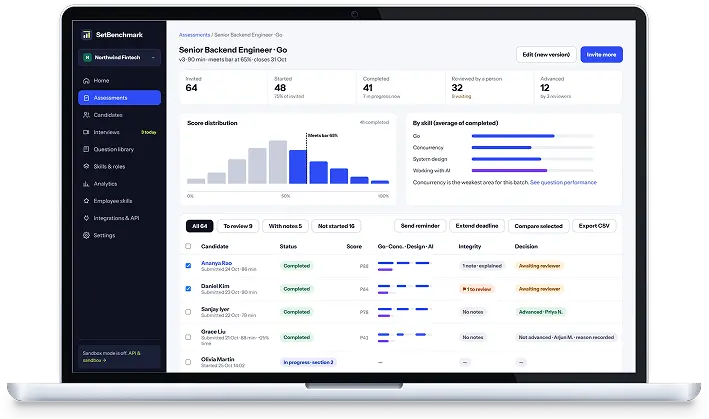
Campus hiring brings huge volumes in short windows. A good online assessment lets you see every eligible student, not just those from a few top-tier colleges, and shortlist on verified skill rather than CGPA alone.
Follow this 7-step blueprint to organize high-integrity, high-throughput university drives that surface standout engineering talent efficiently.
Define what a good graduate looks like
Agree with engineering managers on three to five core skills that actually predict first-year success in your graduate roles.
For most junior software engineering roles, these are structured problem-solving, clean programming fundamentals in any language, basic SQL querying, debugging ability, and clear communication.
Build a short, balanced test
Keep the total duration under 90 minutes. Longer tests drastically lower completion rates without meaningfully improving evaluation signal.
- 20 minutes of CS fundamentals:Multiple-choice questions on data structures, time complexity, and core networking/OS concepts.
- 45 to 60 minutes of hands-on coding:Two problems (one foundational, one intermediate) in the student's choice of programming language.
- 10-minute practical debugging task:Finding and fixing a logical defect in an existing function, which reveals practical development intuition.
Plan the drive logistics
- Share a single registration link with automatic eligibility criteria, or batch-upload verified student lists from each university placement cell.
- Schedule a lightweight 15-minute practice test 3–5 days prior, allowing students to verify browser compatibility, webcams, and network connections.
- Configure proctoring levels appropriate for the tier and inform students upfront regarding snapshots, screen locks, and data retention windows.
- Anticipate intermittent connectivity: use a platform with local auto-save that safely caches code keystrokes and seamlessly resumes if network drops.
Set cut-offs dynamically
Avoid fixing rigid percentage cut-offs prior to seeing cohort performance. Inspect the overall score distribution curve and match your shortlist volume to available engineering interview capacity.
Audit the cohort distribution to ensure shortlists aren't skewed unfairly against specific regional colleges, and investigate specific questions with abnormal drop-offs.
Review integrity flags before shortlisting
Inspect high-confidence flags—such as near-identical abstract syntax trees across peers or a proxy substitute on camera—before finalizing shortlists.
Never disqualify candidates automatically on raw telemetry; always have a designated human reviewer inspect side-by-side evidence.
Move fast to interviews
Top graduate candidates receive multiple simultaneous offers. Invite high performers into automated AI first-round interviews or live panel interviews within 48–72 hours.
Replay their assessment code during the interview so the discussion naturally builds on work they already proved they can write.
Learn and calibrate for next season
Correlate assessment scores against interview pass rates and subsequent 6-month on-the-job ratings across colleges.
Retire questions with high leakage risk, adjust rubric weightings, and refine university partnership tiers for the next campus cycle.
Tier 2 & Tier 3 Campus Hiring at Scale
Great coders exist everywhere. Standardizing on real-world engineering tasks opens your hiring funnel to brilliant self-taught developers across every university.
SetBenchmark handles thousands of concurrent exam-takers with localized Indian server infrastructure, offline recovery, and DPDP-compliant candidate data privacy.