How to assess developers in the age of AI
AI assistants write a lot of code now. The skills that separate strong engineers have moved to planning, reviewing and verifying. Your assessments should move with them.
Most engineering teams now write code with an AI assistant or coding agent beside them. Yet many technical assessments still ban every tool and ask candidates to reverse a linked list from memory. That mismatch hurts both sides: candidates are tested on work they rarely do, and employers learn little about how a person will actually perform.
This guide explains what has changed, which skills matter more now, and how to design assessments that measure them fairly.
What changed in day-to-day engineering
AI tools are good at producing plausible code quickly. They are less reliable at understanding a business rule, noticing a subtle bug or knowing when a test is wrong. The engineer's job has shifted towards deciding what to build, breaking it into steps, checking the output and owning the result.
In practice, the strongest engineers using AI do a few things consistently: they write clear, specific prompts; they read every suggestion before accepting it; they run and extend tests; and they push back when the AI suggests a shortcut that breaks a rule.
Skills to assess now
Problem framing & decomposition
Turning a vague stakeholder request into concrete implementation steps, edge cases, and clear acceptance criteria.
Prompting & agent delegation
Giving an AI assistant or coding agent sufficient architectural context and constraints to be genuinely productive.
Critical code review
Spotting incorrect, insecure, unscalable or over-complicated suggestions generated by AI models.
Verification & test writing
Writing and running automated test suites, testing boundary conditions, and validating live outputs.
Sample 75-minute assessment for a backend engineer
A balanced assessment mixes tasks with different AI policies, so you see both fundamentals and real-world working style:
Fundamentals & Concurrency Debugging
Find and fix a race condition or concurrency defect in a short function. Shows whether the candidate understands the code they will ultimately be reviewing.
Real API Task with AI Assistant
Add idempotency and retry handling to an existing payments endpoint, complete with unit and integration tests. Score the prompting process as well as the output.
Directing a Coding Agent
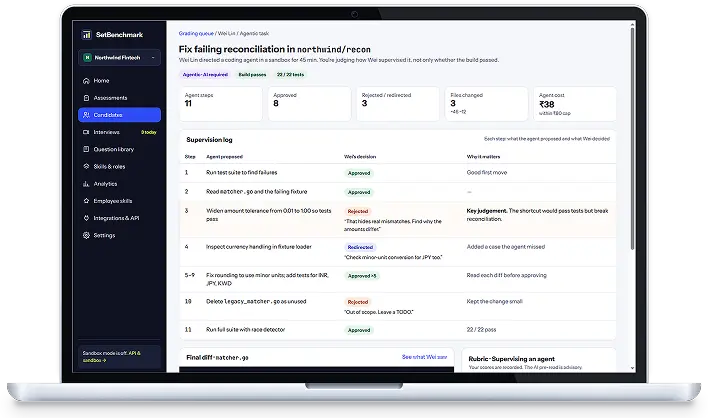
Extend a financial reconciliation service with a coding agent, where one proposed agentic change subtly alters a business rule to make a test pass. Candidate must spot and correct it.
Trade-Off Explanation
A short written summary explaining the principal architectural trade-offs and performance assumptions made during the test.
The Bottom Line
AI hasn't made technical assessment obsolete. It has changed what good looks like.
Test fundamentals briefly, test real work with real tools, and score judgement as carefully as correctness. You'll hire engineers who are productive with AI from their first week.